Equity Loan

Unlock your asset’s value

A home equity loan (a.k.a. second mortgage) lets you borrow against your private property’s value — even while you’re still repaying your current mortgage. This includes cash-out refinancing, mortgage equity withdrawal, and property equity loans. You retain ownership while using your home as collateral.


Outside view of Large Building

Access large sums
beyond personal loan limits

No restrictions on fund usage

Access large sums
beyond personal loan limits

No restrictions on fund usage

Key Benefits

Home Equity Loan: A Smart Way to Unlock Property Value

  • Access large sums beyond personal loan limits

  • Enjoy lower interest rates than unsecured loans

  • Free up funds for investment opportunities

  • No restrictions on fund usage

How Much Can You Borrow with a Home Equity Loan?

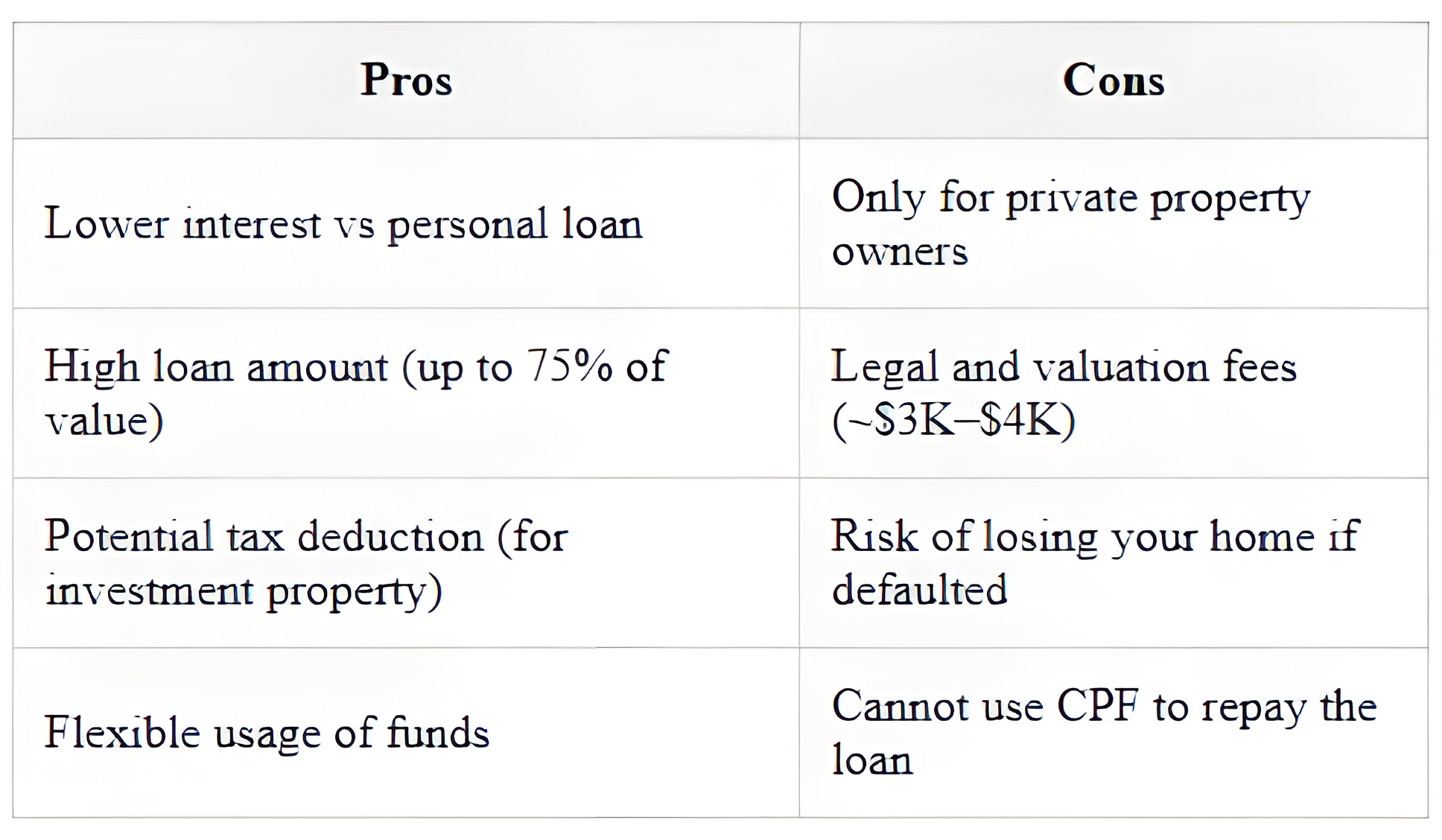
Home equity loans follow standard mortgage regulations. You must maintain a minimum Loan-to-Value (LTV) ratio of 25%, meaning you can borrow up to 75% of your property’s market value, assuming it’s fully paid off.

Keep in mind:

  • You cannot cash out the CPF portion used for your property’s down payment or mortgage.
  • The Total Debt Servicing Ratio (TDSR) applies, limiting your total monthly loan repayments to 55% of your monthly income.
  • TDSR is waived if you’re borrowing 50% or less of your property’s value.
  • The final loan amount will also depend on your credit history and financial profile.

To get an estimate of how much you can borrow, try using our affordability calculator.

Eligibility


  • Only available for private properties (HDB not eligible)
  • Executive Condos (ECs) must complete the 5-year MOP
  • Must meet Total Debt Servicing Ratio (TDSR) requirements
  • LTV (Loan-to-Value) limit: up to 75% of property value
  • CPF-used amounts are not eligible for cash-out

What if I Don’t Meet TDSR?

  • Consider alternative lenders licensed by the Ministry of Law
  • Offer bridging loans up to 3 years
  • Interest rates: 7–8% p.a. (still lower than typical 9–10% for personal loans)
  • Some offer interest-only servicing for initial periods

Costs to Expect

  • Legal & valuation fees: ~$3,000 to $4,000
  • These upfront costs can eat into your cash-out (e.g., 4% on $100,000)
  • Monthly repayments required (no CPF usage allowed)
  • Risk: Defaulting may lead to loss of your home

Fund Usage

No restrictions on use, but be cautious:

  • Bad use: luxury items, vacations, unnecessary renovations
  • Good use: repaying high-interest debts, investing, business capital
  • Risk: You must be confident you can repay to avoid foreclosure

Pros vs Cons of Home Equity Loan

If you choose to refinance from an HDB concessionary loan to a bank loan, the decision is irreversible—you will no longer be able to switch back to an HDB loan in the future.

In the current high-interest environment, HDB loans remain attractive, offering a stable concessionary rate of 2.6% (CPF Ordinary Account rate + 0.1%). In contrast, bank loan rates are currently upwards of 3.7%.

However, in a low interest rate environment—such as between 2009 and 2019—bank loan rates were often lower than the HDB concessionary rate, making them a more cost-effective option during that period.
Understand Your Mortgage

Mortgage Loan

Affordability Assessment

Click this card to read more

What loans are available for different property types?

What is the Progressive Payment Scheme (PPS)?

Click this card to read more

Mortgage LoanWe make banks bid

Click this card to read more

Equity loan

Click this card to read more

Mortgage Refinance
Switching Lenders Can Save You Money.

Best solutions

Let’s work on your project together

How do I apply for a home equity loan?

Our consultation is always in sync with your strategy

Let’s Supercharge Your Company Financial Growth

Call us : Office  (65) 6420 3068

Whatsapp us:  (65) 8058 8598